Tune In, Drop In: Using Sound to Find the Coast's Most Spectacular Hidden Beaches
Forget the travel apps for a minute. Close the review tabs. Put the phone in your pocket.
Now listen.
The coast is talking constantly — in the crash and draw of surf, the distant bark of a pinniped colony, the chatter of shorebirds riding thermals above a protected cove. For most travelers, this is background noise. For the ones who know what to pay attention to, it's a map.
This is a guide to reading the ocean's acoustic landscape — and using what you hear to find beaches, coves, and coastal experiences that most people walk right past.
Why Sound Works as a Navigation Tool
Let's start with the science, because it's actually pretty fascinating.
Sound travels remarkably well over water and through coastal terrain. A seal colony can be audible from over a mile away on a calm day. The low, resonant boom of waves entering a sea cave carries farther than you'd expect. Bird colonies — particularly nesting seabirds like murres, puffins, and cormorants — create distinctive, complex soundscapes that indicate specific habitat types. And the rhythm of breaking waves changes measurably depending on the underwater topography beneath them.
Marine biologists use acoustic monitoring extensively to track animal populations and assess habitat health. Whale researchers can identify individual animals by the specific frequency signatures of their calls. Oceanographers use underwater hydrophones to map current patterns. The underlying principle in all of these applications is the same: sound carries information about the physical and biological environment in ways that visual observation alone can't match.
Travelers can tap into a simplified version of this. You don't need a hydrophone or a marine biology degree. You need to slow down, pay attention, and know what you're listening for.
The Sounds That Lead to Good Places
Seal and Sea Lion Colonies
The bark of California sea lions is one of the most recognizable sounds on the West Coast — a loud, rhythmic honking that carries well in the marine layer. But harbor seals, which are quieter and more widely distributed, produce a subtler mix of grunts and splashing that rewards closer attention.
Where you find haul-out colonies, you typically find protected, low-traffic shoreline. Seals are sensitive to human disturbance and tend to congregate on beaches and rock shelves that aren't heavily visited. Following the sound of a seal colony often leads to quieter, more remote stretches of coast.
Important caveat: keep your distance. Federal law under the Marine Mammal Protection Act requires that you stay at least 50 yards from seals and sea lions. Use the sound to locate the area, then find a vantage point that lets you observe without disturbing. The beach adjacent to a haul-out site is often spectacular precisely because it's off the beaten path — and you should keep it that way.
Seabird Activity
Seabirds are phenomenal indicators of coastal productivity and geography. A noisy concentration of birds working the water's surface — diving, wheeling, calling — almost always signals an upwelling or bait school below. That same activity, when it's happening near shore, often marks a point, headland, or underwater feature that creates interesting water conditions and, frequently, a sheltered beach on the lee side.
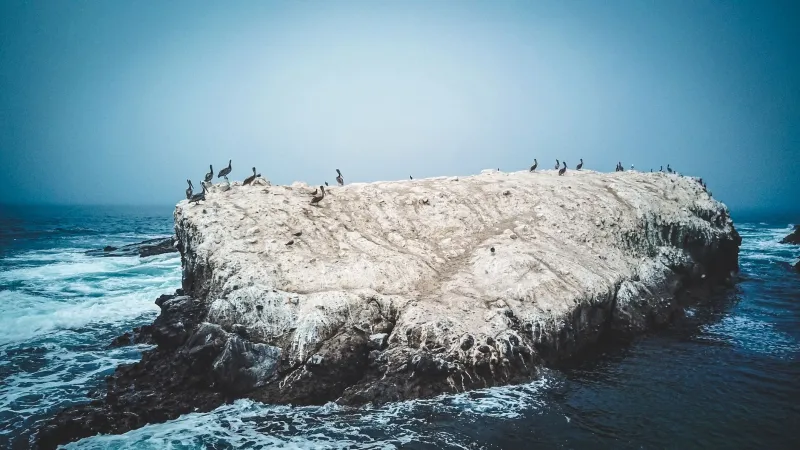
Nesting colonies are even more useful as landmarks. Murres and cormorants nest on sea stacks and cliff faces, and their colonies are loud, distinctive, and persistent throughout spring and summer. On the Pacific Coast, a dense nesting colony often indicates that you're near a protected offshore rock or island — and those formations almost always have interesting water and shoreline nearby.
On the East Coast, pay attention to tern colonies. Common terns and least terns nest on barrier islands and remote sandy spits — exactly the kinds of places most beach crowds never reach. The sound of a tern colony in the distance is frequently worth following.
Wave Patterns and Cave Resonance
This one takes a bit of practice, but it's deeply satisfying once you tune into it.
Waves produce different sounds depending on what they're hitting and what's beneath them. A long, deep booming sound — especially one with a slight echo quality — usually means waves are entering a sea cave or surge channel. These formations are almost always accompanied by spectacular visual scenery and, often, a hidden cove or beach accessible at low tide.
Shorter, sharper wave sounds with a higher pitch typically indicate shallow, rocky substrate. The rolling, hissing sound of waves on a sandy beach is distinct from the clatter of waves on cobble. Once you've heard each a few times, you can start to distinguish them from a distance — and use those distinctions to navigate toward or away from specific beach types depending on what you're after.
A sudden drop in wave sound as you move along a headland often means you've found a natural windbreak or cove on the other side. That's worth investigating.
Whale Calls and What They Mean for Travelers
You're unlikely to hear a whale call with the naked ear from shore under normal conditions — their vocalizations are often at frequencies that carry better underwater. But during certain times of year, particularly during gray whale migration season along the Pacific Coast (December through May) or humpback feeding season in the Gulf of Maine (summer and fall), the activity of whales near shore creates secondary acoustic cues that are very much audible.
The explosive blow of a surfacing whale is unmistakable and can carry several hundred yards on a calm day. Breaches and tail slaps create deep, resonant thuds that travel across the water surface. If you hear these sounds from a coastal trail or bluff, you're near active whale habitat — and that habitat tends to correlate with nutrient-rich, biologically productive coastal zones that are worth exploring more broadly.
Some of the best shore-based whale watching spots in the country — Point Reyes National Seashore in California, Cape Ann in Massachusetts, the Outer Banks in North Carolina — are as much about listening as looking.
How to Practice Acoustic Coastal Navigation
You don't need to travel anywhere exotic to start developing this skill. Any coastal access point will do.
Start at dawn or dusk. These are the quietest periods in terms of human activity and the most acoustically active periods for wildlife. Wind is typically calmer, which means sound carries farther and more clearly.
Find a high point. Bluffs, headlands, and elevated coastal trails give you a broader acoustic field. Sound that would be masked at beach level often becomes clear from 50 or 100 feet up.
Close your eyes for two minutes. Seriously. Removing visual input forces your brain to actually process what it's hearing. Most people are surprised by how much they missed when they open their eyes again.
Keep a simple log. Note what you hear, where you are, and what you find when you investigate. Over time, you'll build a personal reference library of acoustic signatures for your home coast or favorite travel regions.
Three US Spots to Practice Your Listening
Point Reyes National Seashore, CA — Elephant seal colonies, nesting murres, and gray whale migration routes all converge here. Acoustically, it's one of the richest coastal environments in the country.
Acadia National Park, ME — The rocky coastline here creates extraordinary wave acoustics, including several sea caves accessible at low tide. Harbor porpoises and harbor seals add biological sound layers throughout summer.
Padre Island National Seashore, TX — The longest undeveloped barrier island in the US is a nesting ground for Kemp's ridley sea turtles and hosts large tern and skimmer colonies. The acoustic landscape here is completely different from the Pacific Coast — flatter, wider, with the sound of the Gulf carrying differently across the shallow water.
The Quietest Beaches Are Waiting
The coastline rewards curiosity. And it turns out that curiosity doesn't have to be purely visual — the best coastal travelers have always used all of their senses to navigate the shore.
Next time you're on the coast, before you pull up a map or scroll through reviews, just stop for a moment and listen. The ocean has been giving directions all along.