Ride the Moon: How Lunar Timing Can Make or Break Your Next Coastal Adventure
Here's something most travelers never think about when they're planning a beach trip: the moon. Not in a mystical sense — in a purely practical, this-will-completely-change-what-you-experience sense. The lunar cycle is one of the most powerful forces shaping what you'll find when you show up at the coast, and almost nobody outside of serious surfers, fishermen, and marine biologists pays it any real attention.
That's starting to change. A growing number of adventure travelers, wildlife enthusiasts, and coastal explorers are building their trip itineraries around moon phases — and the results are genuinely impressive. Here's what you need to know.
Tides 101: The Moon Is Pulling the Strings
Before we get into the good stuff, a quick refresher on why any of this matters. The moon's gravitational pull is the primary driver of Earth's tides. As the moon orbits our planet, its gravity tugs at the ocean's water, creating bulges that we experience as high and low tides. The cycle repeats roughly every 12 hours and 25 minutes — which means tides shift by about 50 minutes each day.
But not all tides are created equal. Twice a month, during the new moon and full moon phases, the sun and moon align in a way that amplifies their combined gravitational pull. The result is what's called a spring tide — not named after the season, but from the Old English word meaning "to leap." Spring tides produce the highest highs and the lowest lows of any given month.
In between, during the quarter moon phases, the sun and moon pull at right angles to each other, partially canceling out the effect. These are neap tides — calmer, shallower swings between high and low.
Knowing which type of tide is happening when you arrive at the coast isn't just trivia. It fundamentally changes what the shoreline looks like and what you can do there.
Spring Tides: When the Ocean Shows You What It's Hiding
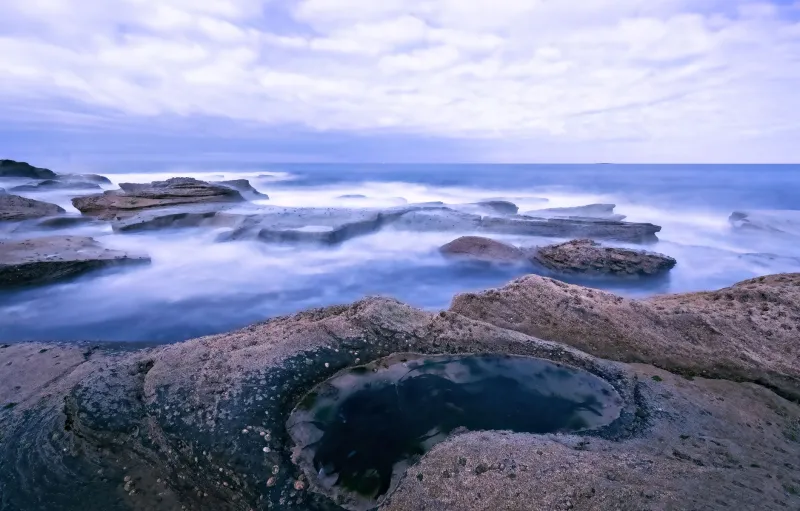
If you've ever wanted to explore tide pools, there is no better time to do it than during a low spring tide. The water pulls back further than usual, exposing rocky shelves and reef structures that spend most of the month completely submerged. What you find there — sea stars, nudibranchs, anemones, hermit crabs, small fish trapped in pools — is a window into an ecosystem that most people never get to see up close.
The Pacific Northwest is legendary for its tide pool ecosystems, and places like Fitzgerald Marine Reserve in Moss Beach, California, or Haystack Rock in Cannon Beach, Oregon, become genuinely extraordinary during a low spring tide. Serious tide poolers track the NOAA tide prediction tables obsessively, targeting days when low tide falls below zero feet — which only happens a handful of times each year and almost always coincides with new or full moon periods.
Pro tip from marine biologist and coastal guide Sarah Henning, who leads tide pool tours in Northern California: "Most people show up at the beach whenever it's convenient and hope for the best. If you look up the tide chart before you book your vacation and aim for a minus tide during a new moon, you'll see things that the weekend crowd never gets to see."
Neap Tides: The Secret Weapon for Calm-Water Kayaking
While spring tides are great for exploration, they're not always ideal for paddling. Strong tidal currents — which intensify during spring tide periods — can turn a casual kayak trip into an exhausting battle against the water. That's where neap tides shine.
During neap tide periods, tidal flow is gentler and more predictable. For sea kayakers, stand-up paddleboarders, and anyone exploring sheltered coastal waterways, this is the sweet spot. Places like the Chesapeake Bay's quieter tributaries, the barrier island lagoons along the Georgia coast, or the estuaries of the Olympic Peninsula in Washington all become more forgiving — and more beautiful — when the tidal swings are modest.
Full Moon Nights: The Wildlife Viewing You're Missing
There's another dimension to lunar timing that goes way beyond tides: the effect of moonlight on marine wildlife behavior. And this one is seriously underappreciated by most travelers.
Sea turtle nesting season along the Gulf Coast and Atlantic shorelines of Florida runs roughly from May through October. Female turtles prefer to come ashore at night, and while they don't strictly follow the lunar calendar, full moon nights — when the beach is washed in natural light — are reliably active and make for dramatic wildlife viewing experiences. Several Florida beach communities, including Melbourne Beach and Juno Beach, offer ranger-led turtle watches that are timed around peak nesting activity.
Bioluminescent bays are another phenomenon where moon phase timing is critical — and in this case, you actually want the opposite. New moon nights, when the sky is darkest, produce the most vivid glow from dinoflagellates in places like Mosquito Lagoon in Florida or the waters around Puerto Rico. Plan a bioluminescence kayak tour around a new moon and you'll be stunned. Show up during a full moon and the ambient light washes out much of the effect.
Practical Tools for Moon-Aware Trip Planning
Getting started with lunar travel planning is easier than it sounds. A few resources worth bookmarking:
- NOAA Tides & Currents (tidesandcurrents.noaa.gov): The authoritative source for tide predictions at thousands of US coastal stations. You can look months ahead and find those coveted minus tides.
- Tide Alert apps: Several solid iOS and Android apps (Tide Alert, MyTide) let you visualize tide curves for specific locations and overlay moon phase data.
- TimeandDate.com: Useful for checking moon phase calendars and planning around new and full moons.
- Local guide knowledge: This is genuinely undervalued. Booking with a local kayak outfitter, tide pool guide, or wildlife tour operator means you're automatically tapping into someone who plans every outing around these cycles.
Putting It All Together
The simplest version of this approach: if you want maximum tide pool access and dramatic low-water exploration, target the two or three days around a new or full moon and look for predicted low tides below 0.5 feet on the NOAA chart. If you want calm paddling and relaxed coastal cruising, aim for the week between those peaks. If nighttime wildlife and bioluminescence are the goal, new moon phases are your friend.
None of this requires a degree in astronomy. It just requires a little planning and a willingness to let the ocean — and the moon pulling at it — set the agenda.
The coast is always there. But the coast at exactly the right moment in the lunar cycle? That's something else entirely.